What was announced
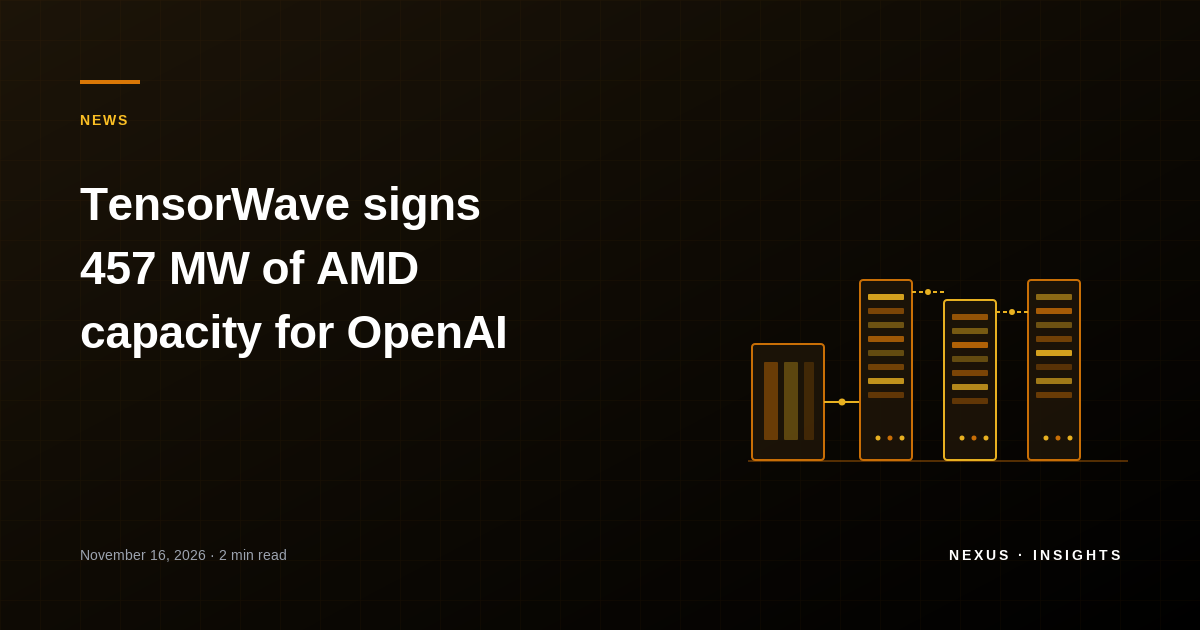
On November 16, 2026, TensorWave announced a six year agreement with OpenAI. TensorWave will provide 457 megawatts of IT capacity across multiple US data center sites, powered by AMD Instinct MI455X GPUs.
The capacity is being built for AMD Helios rack scale systems and will run as dedicated, single tenant capacity for OpenAI. TensorWave expects capacity to begin coming online in the first half of 2027, with full deployment expected by early 2028.
Neither company disclosed the value of the contract or named the sites.
Why it matters
TensorWave says it is the first neocloud publicly announced as an infrastructure provider supporting the AMD and OpenAI partnership. The company also called it its largest deployment to date.
Frontier labs are now buying hundreds of megawatts at a time from specialist GPU clouds, not only from hyperscalers. And the deal is described in megawatts of IT capacity, not GPU counts. Power is the unit buyers and sellers are pricing.
What it means for power and hosting
The sites are being designed specifically for Helios racks, with Ethernet scale out networking across racks. A site built around one rack design needs its power, cooling and network planned around it from day one.
457 MW is IT capacity. That is the load the computers draw, so the power a site has to secure is a separate and larger planning question.
My take
The timeline is the story for me. First capacity in the first half of 2027 and full deployment by early 2028 means the power and buildings behind this mostly have to be lined up now. That puts a premium on sites that are already energized or close to it.
It also widens the buyer pool. Hyperscalers are not the only ones shopping for powered capacity anymore. Neoclouds with anchor contracts from frontier labs are shopping too, and they move fast.
What I'm watching next: which sites TensorWave names, whether more neoclouds get named under the AMD and OpenAI partnership, and how much of the 457 MW lands on existing power versus new builds.
If you had to place hundreds of megawatts of GPUs by early 2028, would you bet on energized sites you can get today or new builds with bigger power later?